
Blog
Evolving the enterprise data stack for AI
Why enterprises don't trust AI with business decisions yet, and the three changes to the data stack that fix it. Delete, derive, reinvent.
We've been talking with enterprise leaders about what blocks AI adoption, and the conversations converge on one word: trust. Nobody doubts that a model can write SQL. They doubt the number that comes back. The first time an agent's answer disagrees with the board deck, the AI initiative stalls, and it should.
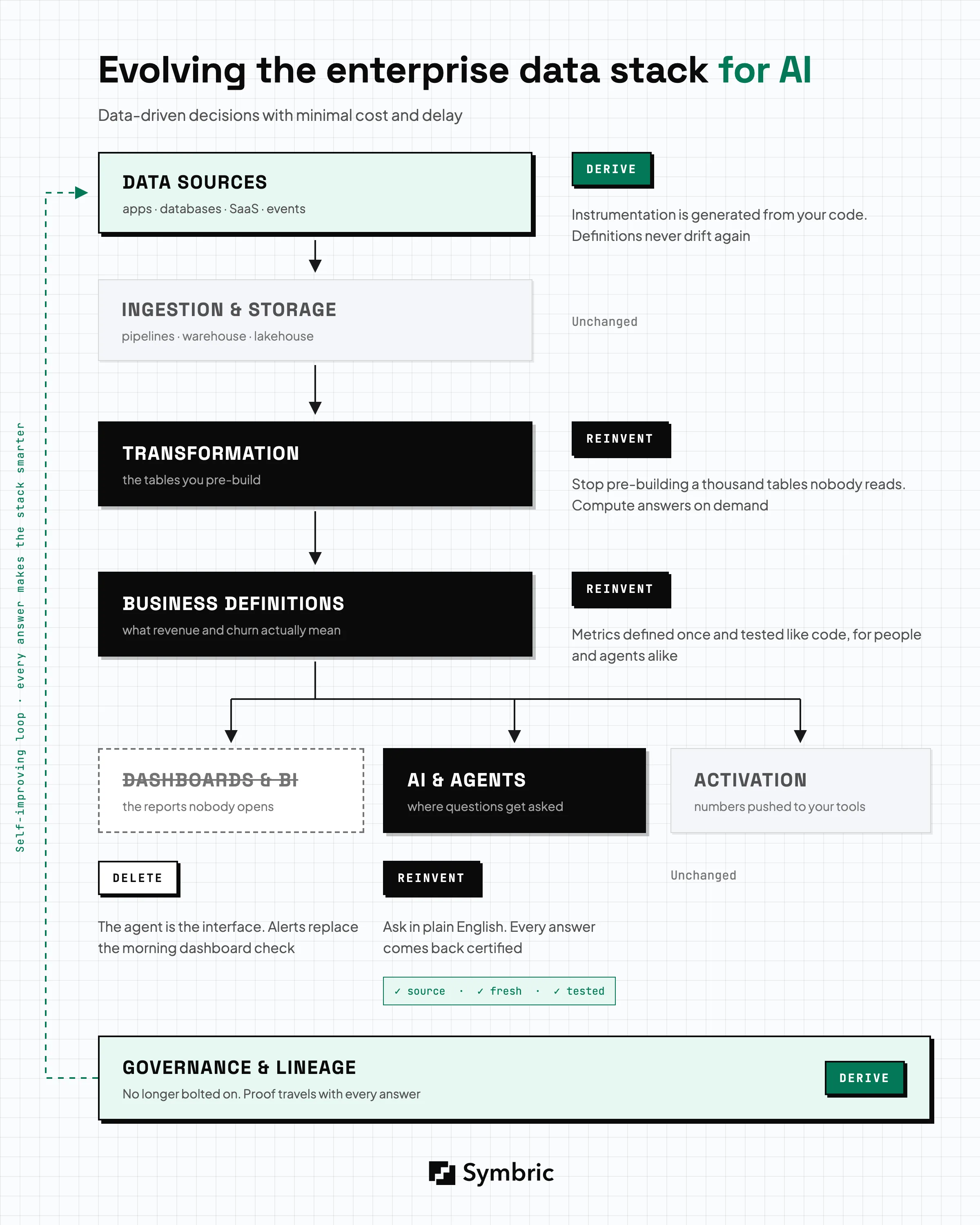
The distrust is rational. Today's stack was built for a world where people supplied the trust. Every dashboard carries its own version of revenue. Definitions live in one analyst's head, drift quietly in another team's queries, and by the time a number reaches a decision maker its provenance is gone. Human analysts papered over this because they knew which numbers to double-check. An agent inherits the same mess with none of that tribal knowledge, then delivers wrong answers with perfect confidence.
The fix is smaller than a rebuild. Most of the stack is commoditized and fine: pipelines, warehouses, lakehouses, and the reverse-ETL layer that pushes numbers into your tools can all stay. Three changes do the work.
Delete the dashboard layer.
When the agent is the interface, the report factory loses its purpose. Teams ask questions in plain English and get answers in seconds; alerts replace the morning dashboard check. The hundreds of reports nobody opens stop costing money and, worse, stop multiplying conflicting definitions.
Derive what people maintain by hand.
Instrumentation gets generated from application code, so what's tracked always matches what the product does. Governance and lineage get recorded as answers are produced, so proof exists as a byproduct of use. Hand-maintained tracking plans and bolted-on catalogs drift the day they're written; derived ones can't.
Reinvent transformation and business definitions.
Metrics get defined once, in code, with tests, and shared by people and agents alike. Revenue means one thing everywhere. Transforms get computed when a question is asked, and pre-building a thousand tables on the chance someone might look becomes unnecessary, along with the compute bill that came with it.
Together these three changes convert trust from a feeling about the data team into a property of each answer. Every answer arrives certified: the source it came from, how fresh it is, and the definition tests it passed, attached like a receipt. Certified here means it passed the checks its own definition carries, not an outside audit. A CFO can act on a certified number for the same reason they act on an audited statement. The proof travels with it.
There's a compounding effect, too. Every question asked, every correction made, every rule confirmed feeds back into the definitions, so the stack gets smarter with use. The system you have today is the worst it will ever be.
The payoff is the thing every leader we spoke with actually wants: business decisions made on accurate numbers, in seconds rather than sprint cycles, at a fraction of today's operating cost. That's the stack we're building at Symbric.