
Blog
Your semantic layer is currently a person
What a semantic layer is, why yours is probably a person, and why AI turned it into the thing that decides whether a number is worth acting on.
Every company already has a semantic layer. In most of them it is a person, and that is why AI keeps producing numbers nobody can act on.
What is a semantic layer?
A semantic layer is the place where business definitions are written down once, in code, apart from any single report or tool. Revenue means this. An active customer did that, inside this window. Churn excludes these accounts for this reason. Your warehouse holds a column named amt_usd_net, and the layer is what says that column, filtered these three ways and joined to that table, is what this company means by net revenue.
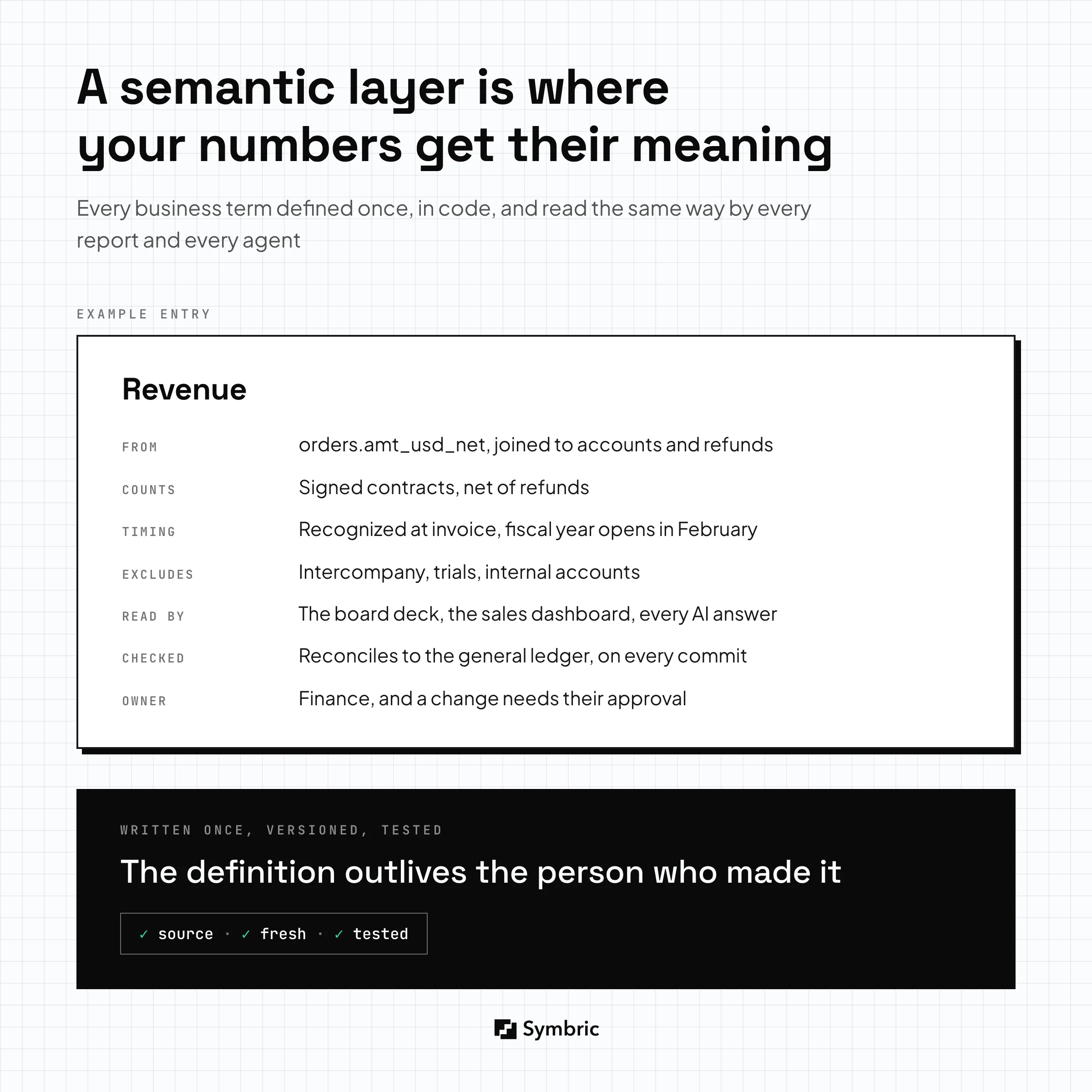
Some of that is written down already. Every BI tool ships a version of one, and somebody on your team spent weeks deciding what revenue means before it went into a model file. The rest lives in people: the analyst who knows which dashboard lies, the finance spreadsheet that corrects the number before it reaches the board, the WHERE clause pasted between queries for four years. None of that is written anywhere a tool can read, and none of it appears on a system diagram.
The arrangement held for 20 years because people were the ones reading the numbers. Someone carrying definitions in their head also carries judgment about when a number looks wrong, and that judgment did real work without ever appearing on a budget line. Sales says 4.2 million, finance says 3.9, one counts a deal at signature and the other at invoice, and somebody in the room knows why. The meeting costs an hour and the decision survives.
Why AI answers fail on enterprise schemas.
An agent has none of that, and the size of the gap is now measurable. On a public benchmark of tidy academic test databases, one widely used model answers 86.6 percent of questions correctly. Rerun it on the same benchmark's real enterprise schemas, where tables run past a thousand columns and sometimes past three thousand, and it answers 10.1 percent.
The interesting part is how it fails. Most of those failures are queries that run perfectly. No error, no crash, a well formatted number returned in under a second. What the model gets wrong is which definition to use: the filter nobody mentioned, the join that quietly doubles a count, the fiscal calendar that starts in February. A wrong answer that executes cleanly is indistinguishable from a right one, which means the hour of reconciliation never happens and the number goes straight into the decision.
That is what changes for leadership. Wrong numbers used to be caught by the person who knew better, and now they arrive faster than anyone can check and wearing the same face as the correct ones. Grounded in definitions the business already agreed on, an agent gives the CFO and the account manager the same answer. Guessing, it gives them different ones, and you find out in a board meeting.
One question sorts the two, and it takes no technical vocabulary to ask: what does the system do when it cannot answer? A tool that answers everything is checking nothing. If it cannot name the definition it used, or say what is missing when the definitions do not cover a question, then what sits on top of your data is a chatbot with warehouse credentials.
Written down and tested, a definition outlives the person who made it, and the answer stops depending on who ran the query. At Symbric we derive that layer from the systems a company already runs, keep it current with every commit, and attach the source, the freshness and the checks it passed to every answer that comes out.